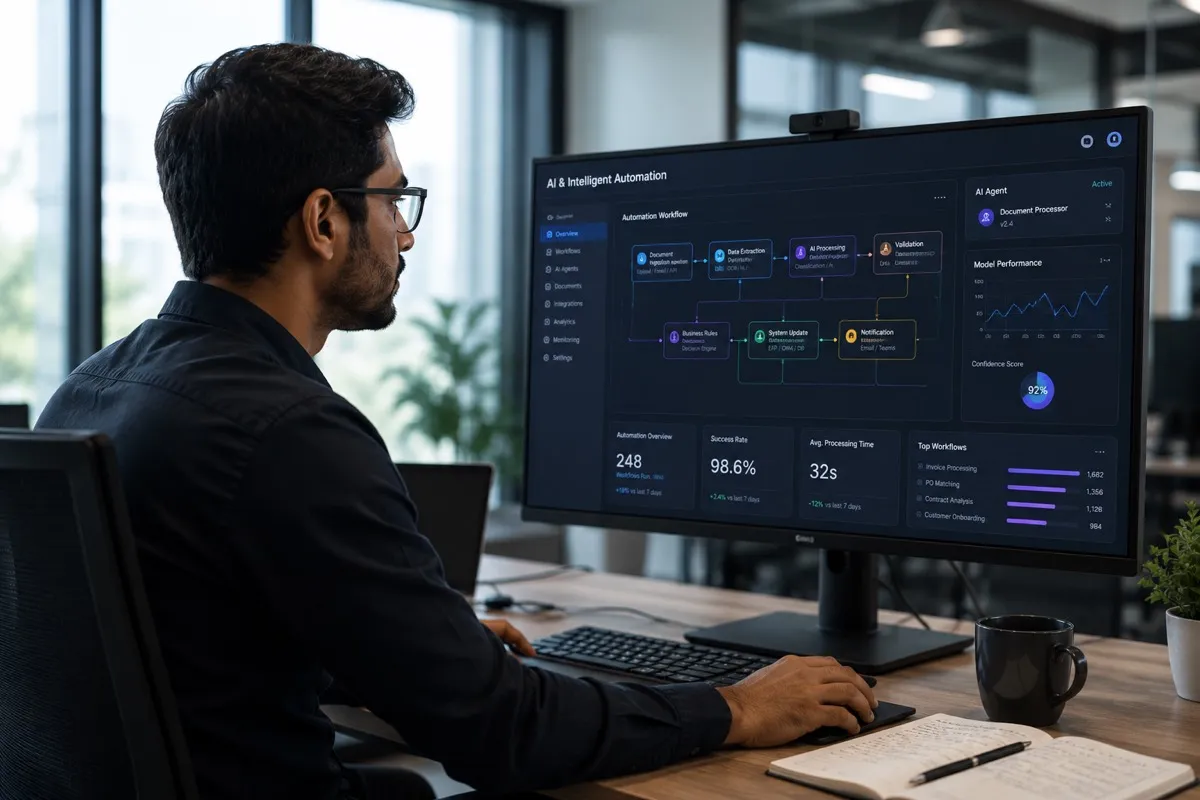
AI & Intelligent Automation
From generative-AI copilots and RAG chatbots to predictive models and MLOps, we build production-grade AI on your own data - with governance and security baked in.
Learn moreOn this page
What we do Section Compose your stack Section AI Solutions Section What we deliver Section How we work Section Industries we serve SectionServices
AI & Intelligent Automation Service Software Development Service Cloud Solutions & Migration Service Cybersecurity & Compliance Service Data Analytics & BI ServiceInsights
Website development cost in India in 2026 IT Strategy Mobile app development cost in India in 2026 IT Strategy ERP implementation cost in India in 2026 IT Strategy ISO 27001 certification cost in India in 2026 Security E-commerce website cost in India in 2026 IT Strategy IT AMC cost in India: why nobody will quote you a price IT Strategy How long does software development take? IT Strategy CRM implementation cost in India in 2026 IT Strategy AI chatbot development cost in India in 2026 Data & AI Website maintenance cost in India in 2026 IT Strategy You cannot protect data you have not classified Security Privileged access management when you do not have a security team Security Object storage costs: what tiering actually saves Cloud Storing time-series data without your database falling over Engineering Building location features for Indian addresses and delivery zones Engineering Do you need a customer data platform, or four tools talking to each other? Data Operationalising consent under the DPDP framework Compliance Carbon reporting is arriving in IT procurement Business Sharding a database: the last resort, and how to delay it Engineering Migrating between Google Workspace and Microsoft 365 IT Services Choosing an identity provider you will not want to leave Security Managed detection or your own security monitoring? Security Choosing a warehouse management system in India Business Data catalogues and lineage: knowing where a number came from Data Feature stores: solving a problem you may not have yet AI MLOps for teams without a platform group AI Designing billing systems that survive a tax rate change Engineering Barcode and label printing: the unglamorous part of retail software Engineering React Native, Flutter or native: choosing without regret Engineering Choosing a BI tool your team will actually open Data Email archiving and legal hold: what happens when a dispute starts Compliance Change Advisory Boards: making them fast instead of theatre IT Strategy Freshservice vs ServiceNow vs Jira Service Management for Indian mid-market IT Strategy IT asset management: tracking what you actually own IT Strategy Service catalogs people can actually find things in IT Strategy Ticket prioritization: a matrix that survives contact with reality IT Strategy First-contact resolution: the metric that actually predicts helpdesk quality IT Strategy Shadow IT: finding the tools nobody approved Security Knowledge-centered service: writing solutions once IT Strategy Problem management: finding root cause instead of firefighting repeat incidents IT Strategy Major incident management: running the war room properly IT Strategy IT service continuity management vs disaster recovery — the difference Cloud Self-service portals that actually reduce ticket volume IT Strategy AIOps: where AI genuinely helps IT operations AI Release management: coordinating deployments across multiple teams IT Strategy Request fulfilment: automating the approvals nobody reads IT Strategy IT chargeback and showback: making departments see their IT cost IT Strategy Availability management: defining uptime targets that mean something IT Strategy Choosing between GPT, Claude, Gemini and open-source models for a specific task AI Multimodal AI: when combining text, image and voice actually helps AI Synthetic data for training: when it helps and when it quietly breaks a model AI Red-teaming your own AI system before someone else does AI How long you must keep records: the Indian retention landscape Compliance Delivering video to Indian audiences without burning bandwidth Engineering Patch management for a Windows fleet you didn't design Security Remote monitoring and management tools for running an MSP practice IT Strategy Progressive Web Apps for Indian retail: when they beat a native app IT Strategy Jamstack and static-first sites for content-heavy businesses IT Strategy Headless CMS: choosing one for an Indian content team IT Strategy WebAssembly: where it earns its complexity IT Strategy Server-Sent Events vs WebSockets: picking the simpler one IT Strategy Edge functions and Indian latency Cloud Dark mode done properly, not just inverted colours IT Strategy Browser extensions: building and distributing one IT Strategy Endpoint detection and response for a small IT team Security Mobile device management: BYOD in an Indian office Security VPN and remote access design after hybrid work became permanent Security Wi-Fi and LAN design for a growing office IT Strategy Backup software selection: what actually restores Cloud Micro-frontends: when splitting the frontend is worth it IT Strategy CSS architecture: utility-first vs component-scoped styles IT Strategy Progressive enhancement: building for the browser that fails IT Strategy Accessibility testing automation: catching issues before a human review IT Strategy Font loading strategy: the invisible performance cost IT Strategy CLI tool design: building a command-line tool developers actually adopt IT Strategy Vector databases: choosing one and what changes as you scale AI AI-assisted code review: what it catches and what it misses AI Explainability: what "why did it do that" actually requires you to build AI The cost of AI hallucination: measuring business impact, not just accuracy AI Why your Android notifications do not arrive on Indian phones Engineering App size is a conversion metric Engineering Hosting government workloads: MeitY empanelment Cloud IRDAI's cyber security rules and insurance software Security Aadhaar eSign or DSC: signing documents in India Security Pricing SaaS for the Indian market Cloud Why your enterprise pilot never converts Cloud IT and security for a twenty-person company Security Running a proof of concept that decides something Cloud Building a partner channel that actually sells Cloud Building a team in India beyond Bengaluru Cloud When your key engineer resigns Cloud Dark patterns: what Indian e-commerce may not do Security RBI's IT governance rules for banks and NBFCs Security Accessibility law in India: RPwD and government sites Cloud When a stranger emails to say you have a bug Security Telling customers you are down Cloud Surviving the festive peak Cloud The vendors your vendors use Security Moving between cloud providers Cloud A privacy policy that matches your product Security Security training people do not ignore Security Building video KYC into a financial product Security Bharat Bill Payment System: how it fits together Cloud Designing a credit decisioning engine Data & AI Fraud detection without blocking real customers Data & AI Voice and IVR in Indian languages Data & AI Choosing a CRM or ERP for an Indian SMB Cloud Implementation is a discipline, not a handover Cloud Writing a tender response that wins Cloud Last-mile delivery software in Indian conditions Cloud Reconciliation: the system nobody designs Cloud GST's Invoice Management System: what it changes Cloud Integrating with India's credit bureaus Data & AI What payroll software must actually handle in India Cloud Getting your app onto Indian phones IT Strategy The admin tool nobody budgets for IT Strategy Churn: measuring it honestly first IT Strategy Notifications: one system, four channels Cloud Hiring and running QA properly IT Strategy Starting a marketplace with nobody on it IT Strategy Renegotiating with a vendor you cannot easily leave IT Strategy Export filing is changing for software exporters IT Strategy When one client is most of your revenue IT Strategy Releasing your own code as open source IT Strategy A design system, or just a component library IT Strategy When to hire a designer, and what to ask for IT Strategy Scope creep is a symptom, not a behaviour IT Strategy Your first data hire Data & AI Insurance an IT services firm actually needs IT Strategy The first forty-eight hours of a breach Security Choosing a licence for software you build IT Strategy Checking a software company is genuine IT Strategy What belongs in a software maintenance contract IT Strategy Securing a WordPress site properly Security GSP or direct: connecting to the GST system Cloud Signs it is time to replace your ERP IT Strategy Why your website does not appear on Google IT Strategy Card tokenisation: what you may no longer store Security The Aadhaar Data Vault: who needs one Security The labour codes and what HR software must change Cloud When an Indian enterprise wants it on-premise Cloud Getting empanelled as a vendor to an Indian bank IT Strategy Measuring whether engineering is getting better IT Strategy Search and sorting in Indian languages Data & AI Reaching users who have no smartphone IT Strategy Estimating cloud cost before you build Cloud White-labelling your product for a partner IT Strategy New listing rules for Indian e-commerce Cloud Telecom cyber security rules: who they catch Security Colocation or cloud for an Indian business Cloud When a customer asks for all their data Security Treating your API as a product IT Strategy A career ladder for a team of twelve IT Strategy Architecture review that is not theatre IT Strategy Should a services firm specialise? IT Strategy Selling to Indian SMBs is a different business IT Strategy Software for teams working in the field Cloud Building a telemedicine product in India Cloud STPI, SEZ or neither: choosing a structure IT Strategy The 45-day rule: getting paid, and paying IT Strategy Running more than one payment gateway Cloud Changing payment gateway without losing customers Cloud Refunds and chargebacks as an operational system Cloud Why your referral programme is losing money Data & AI Continuity planning for an Indian office Cloud The bench: the cost nobody plans for IT Strategy Quoting fixed price without losing money IT Strategy Subcontracting part of a project safely IT Strategy A bug backlog of four hundred is a decision IT Strategy A help centre that actually reduces tickets IT Strategy When a client escalation reaches your CEO IT Strategy Shipping software into a network with no internet Security What a security incident would actually cost you Security The handover from sales to delivery IT Strategy Safe harbour: the obligations you may not know you have Security Hiring your first product manager IT Strategy User research that survives Indian politeness IT Strategy The first five minutes decide everything IT Strategy Moving users from your old product to your new one IT Strategy Shutting down a product without burning customers IT Strategy A/B testing when you do not have the traffic Data & AI Moderating user content on an Indian platform Security What an enterprise buyer looks for on your website IT Strategy Choosing the two numbers your company runs on Data & AI When the direction changes every three weeks IT Strategy Running a remote-first team in India IT Strategy When the client wants AI in it Data & AI Build or buy the tools you run on IT Strategy A customer advisory board that is not theatre IT Strategy Running a beta that tells you something IT Strategy When a competitor undercuts you IT Strategy Saying no to a customer IT Strategy The engineer in the sales call IT Strategy Choosing who to sell to first IT Strategy FSSAI rules that shape a food platform's software Cloud Freelancer, agency or your own team IT Strategy Custom software or something off the shelf IT Strategy Getting your existing software audited IT Strategy Digital transformation, translated IT Strategy Budgeting IT for the year ahead IT Strategy You are paying for software nobody uses IT Strategy ARM instances: real savings, with conditions Cloud Reserved capacity: committing without regretting it Cloud ITIL 4 for Indian IT teams: what to adopt and what to skip IT Strategy The FTP server nobody owns is your biggest quiet risk Security Using DigiLocker for document verification Engineering Building a CMDB that doesn't go stale IT Strategy Credit on UPI: what changes for merchants Business Automating input tax credit reconciliation Business Fixed-price or time-and-materials: which contract to sign IT Strategy GST on software exports: what changed in 2026 Security Data residency rules for Indian fintech Security CERT-In's six-hour breach reporting rule Security What an RBI payment aggregator licence requires Security The EU AI Act and Indian software exporters AI GST e-invoicing: what integration involves Cloud ISO 27001 or SOC 2: which your buyer wants Security Answering an enterprise security questionnaire Security Who owns the code when you outsource Cloud Source code escrow: when a client demands it Cloud Taking over a project from another vendor Cloud Staff augmentation or a managed team Cloud Where your cloud bill actually goes Cloud What UPI integration actually involves Security Building on the Account Aggregator framework Security Integrating with ONDC: what it takes Cloud WhatsApp Business API: costs and constraints Cloud Building for users on a poor connection Cloud Migrating off Tally or an on-prem ERP Cloud Setting up a GCC in Bengaluru Cloud India or Eastern Europe for development Cloud AWS, Azure or Google Cloud for an Indian company Cloud Document processing with AI: what works AI Building a lending app under the 2025 Directions Security Aadhaar eKYC: what you can actually use Security ABDM integration for health software AI Selling software to government through GeM Cloud How Indian SaaS companies bill overseas Cloud Preparing for technical due diligence Cloud ESOPs for an Indian engineering team Cloud What a fractional CTO actually does Cloud Hiring engineers when you are not technical Cloud Writing a software brief that gets good answers Cloud DLT registration: why your OTPs are not arriving Cloud Recurring payments under the 2026 e-mandate rules Security SEBI's CSCRF: what it asks of your systems Security E-way bill integration: rules that bite Cloud Low-code or custom: choosing honestly Cloud Moving from services to a product Cloud Replacing a process that runs on spreadsheets Cloud Designing SLAs that survive a bad month Cloud Modelling Indian names, addresses and phones Cloud Running 24/7 support for global clients Cloud Tax collection and deduction obligations for e-commerce operators Compliance A backup you have never restored is a hypothesis IT Services How to run technical due diligence on a development partner IT Strategy Adding video calling: build, buy, or avoid Engineering Software bills of materials: what buyers are starting to require Security What custom software actually costs in India in 2026 IT Strategy What a solution architect is actually for Business Charging for discovery, and why clients agree Business What an MVP should and should not include IT Strategy Product analytics that does not send personal data to a third party Data Getting GPU capacity for AI workloads in India AI Dedicated team or project outsourcing: an honest comparison IT Strategy Rolling out AI coding assistants without wrecking your codebase AI DNS: the single point of failure nobody owns IT Services The certificate expiry outage, and how to stop having it Engineering Protecting your brand online without a large budget Business Integrating with point-of-sale systems in Indian retail Engineering Knowing what stock you have, across every branch Business Modernising a legacy system without betting the company on a rewrite IT Strategy Integrating your product with Indian accounting systems Engineering Choosing a customer support desk IT Services Multi-tenant SaaS: the four decisions you cannot reverse cheaply IT Strategy API gateway, service mesh, or neither Engineering Deciding which browsers and devices you support Engineering India's DPDP Rules: what the 2026 and 2027 deadlines mean for your systems Security Testing on real devices without buying fifty phones Engineering Fine-tuning, RAG or prompting: choosing the right one Data & AI Replacing nightly CSV files with real integration Cloud What SOC 2 actually costs an Indian company, and how long it takes Security When you need a mobile app, and when a web page will do IT Strategy 12 questions to ask before hiring a software development company IT Strategy The real cost of skipping automated tests IT Strategy HIPAA for Indian teams building healthcare software Security AI agents: where they genuinely help, and where they are hype Data & AI What your RTO and RPO actually commit you to Cloud Why companies build software in Bengaluru - and when they should not IT Strategy Why ERP implementations stall short of adoption IT Strategy Working with an offshore team across time zones IT Strategy Adding an AI copilot to a product that already exists Data & AI How to evaluate an AI vendor's accuracy claims Data & AI What Indian manufacturers get wrong about industrial IoT Cloud What a cloud migration actually costs, and how to budget one Cloud Penetration testing: what it costs and how often you need it Security What a data warehouse costs to build and to run Data & AI What it costs to run an LLM feature in production Data & AI Hiring engineers in Bengaluru: what the market actually costs IT Strategy Monolith or microservices: choosing honestly IT Strategy Do you actually need Kubernetes? Cloud Choosing a database for a new product IT Strategy Zero-downtime database migrations Cloud Event-driven architecture: the pitfalls nobody mentions IT Strategy Caching: where it helps and where it hides bugs Cloud What "AI-first" actually means (and what it doesn't) AI API versioning and deprecation done properly IT Strategy Vendor lock-in: the real risks and the imagined ones Cloud Observability: what to instrument first Cloud Incident response for teams without an SRE Cloud On-call without burning out the team Cloud Feature flags and progressive delivery IT Strategy Is your data actually ready for AI? A 6-point readiness audit AI Secrets management: the basics done properly Security Quantifying technical debt so it gets budgeted IT Strategy Code review that actually catches things IT Strategy Documentation that survives the team that wrote it IT Strategy Why estimates fail on existing systems IT Strategy How to choose a managed IT services partner: a founder's checklist IT Strategy Accessibility: why it turns up in procurement IT Strategy Core Web Vitals and performance budgets IT Strategy Build vs. buy: when a custom AI system beats an off-the-shelf tool AI Background jobs: queues, retries and the work nobody sees Cloud Rate limiting: protecting an API without blocking real users Cloud Why your query is slow: reading an execution plan Cloud Why most RAG chatbots hallucinate - and how we fix it Data & AI Sessions or tokens: choosing how to authenticate Security File uploads: doing it properly at scale Cloud How to measure AI ROI without fooling yourself AI Search relevance: why exact matching disappoints users Data & AI Dates and time zones: the bugs that appear in October IT Strategy 5 cloud migration mistakes that cost enterprises millions Cloud Pagination that does not skip or repeat rows Cloud AI governance doesn't need to be a committee - a lightweight framework for mid-market teams AI Soft deletes: convenient, and a slow-growing problem Data & AI What an hour of downtime actually costs a mid-market company Cloud Multi-region: when latency actually requires it Cloud Calling third-party APIs without inheriting their outages Cloud Monorepo or many repos: choosing a code layout IT Strategy Zero Trust in 2026: a practical roadmap for mid-market teams Security How to interview software engineers properly IT Strategy Why your CI pipeline is slow, and what to fix IT Strategy Infrastructure as code without the sprawl Cloud Load testing that tells you something useful Cloud Idempotency keys: making retries safe Cloud Webhooks that arrive: delivery and receipt Cloud REST or GraphQL: choosing for a real team IT Strategy Why your transactional email goes to spam Cloud Open-source dependencies and the risk you own Security Designing a CI/CD pipeline people actually trust Cloud How we cut a client's data pipeline costs by 62% with AI Data & AI Blue-green or canary: choosing a deployment strategy Cloud Container images: the supply chain nobody audits Security Load testing that tells you something useful Cloud Connection pooling: the limit you hit before CPU Cloud Logging: what to record and what never to record Security Serverless or containers: what actually decides it Cloud Data modelling: normalise first, denormalise deliberately Data & AI Refactoring code that has no tests IT Strategy Getting a new engineer productive in a week IT Strategy API errors: what to return when something goes wrong Cloud Moving data between systems without losing any Data & AI Why it works in staging and breaks in production Cloud REST, GraphQL or gRPC: choosing an API style IT Strategy Why your product emails end up in spam Cloud Generating PDFs and reports without taking the site down Cloud Internationalisation is not translation IT Strategy Frontend state: most of it is not yours to manage IT Strategy Monorepo or many repositories IT Strategy Handling money in software without losing paise IT Strategy The N+1 query and other ways an ORM surprises you Cloud Sending webhooks your customers can rely on Cloud Audit trails: recording who did what Security Permissions: why roles stop being enough Security Dependency upgrades: small and often, or not at all Security Bot traffic: what to block and what to leave alone Security Testing data the way you test code Data & AI Streaming or batch: how fresh does the data need to be? Data & AI Machine learning models degrade quietly Data & AI Prompt injection: the vulnerability with no patch Data & AI SQL injection: still the one that gets people Security Cross-site scripting and the header that limits it Security Storing passwords: what the algorithm choice buys you Security Multi-factor authentication people will actually use Security Choosing a message broker: queue or log Cloud Importing large files without breaking anything Cloud Choosing a frontend framework in 2026 IT Strategy Read replicas: buying capacity, paying in staleness Cloud Removing a feature without breaking trust IT Strategy Concurrency: the bug that only happens in production Cloud Password reset: the endpoint attackers actually target Security SSO: the feature enterprise deals stall on Security Practising failure before production does it for you Cloud Analytics: instrument deliberately or measure nothing Data & AI Mobile releases: you cannot roll back an app IT Strategy Offline-first: syncing is the whole problem IT Strategy API documentation developers can actually use IT Strategy Internal platforms: paving the path rather than policing it IT StrategyGo to
Services Page Industries Page Case Studies Page Technologies Page About Page Blog Page Contact PageNothing matches that.
From cloud migrations to 24/7 security operations, we cover the full technology stack - software, AI, cloud, security and data - delivered by one dedicated partner.
From generative-AI copilots and RAG chatbots to predictive models and MLOps, we build production-grade AI on your own data - with governance and security baked in.
Learn more
Custom web, mobile, and enterprise applications engineered with modern, clean architecture - built to scale, easy to maintain, and shipped fast with battle-tested CI/CD pipelines.
Learn more
We move your infrastructure to the cloud with zero-downtime migrations, cloud-native architectures, and ongoing cost optimization - built to scale as you grow across AWS, Azure, and Google Cloud.
Learn more
Proactive threat detection, penetration testing, and audit-ready compliance for SOC 2, HIPAA, and GDPR. We harden every layer so your data and your reputation stay protected.
Learn more
Turn raw data into confident decisions with real-time dashboards, clean data pipelines, and reporting tailored to the way your business actually works.
Learn moreSelect any combination below and your engagement blueprint builds itself.
Not hype - production-grade AI built on your own data, with governance, security, and measurable ROI from day one.
Custom LLM assistants and RAG chatbots grounded in your own data and docs.
ML models that forecast demand, churn, and risk before it happens.
Automate document, support, and back-office workflows end to end.
Anomaly detection and threat triage that monitors your stack 24/7.
Production pipelines to deploy, version, and monitor models reliably.
Pragmatic roadmaps that put AI to work on measurable business outcomes.
Generative AI, predictive models, and intelligent automation built on your data.
Talk to us about thisA simple, transparent process that ships value early and keeps you in control at every step.
We start by understanding your goals, systems, and constraints - no cookie-cutter proposals.
We architect the solution and a phased plan you can actually execute, with clear milestones.
We implement in thin, reversible slices - shipping value early and de-risking every step.
We monitor, optimize, and support 24/7, staying accountable long after go-live.
We baseline before launch and report against it after, so the value is evidenced rather than asserted.
Each quarter we review what the numbers say and agree the next increment worth building.
A decade of delivering secure, reliable technology across the sectors where uptime and compliance aren't optional.
Secure, compliant platforms for payments, lending, and core banking.
HIPAA-ready systems that keep patient data private and always available.
Scalable storefronts and analytics that stay fast through peak demand.
Cloud-native architecture and DevOps for product teams shipping fast.
Connected operations, edge data, and reliable industrial infrastructure.
Dependable, accessible IT for institutions that serve people at scale.
Most engagements draw on three or four of these at once — a platform build needs architecture, cloud, QA and security working as one team, not four vendors with four contracts. Each practice below states the problems it solves, what is in the box, and the outcomes we hold ourselves to.
Service 01
Systems built around your workflow, not around a licence agreement.
Off-the-shelf software solves the eighty per cent of your business that looks like everyone else's. The remaining twenty per cent — the part that actually differentiates you — is where custom engineering pays for itself. We build the systems that encode how your organisation really works: the approval chain nobody can explain to a vendor, the pricing logic that lives in three spreadsheets, the operational workflow that four departments have quietly built around.
Every build starts with a discovery sprint that maps the real process, not the documented one, and ends with a system your own team can operate and extend. We ship in thin, reversible slices behind feature flags, so business value lands in weeks rather than quarters, and every increment is production-grade — tested, instrumented, and documented — rather than a demo waiting to be rewritten.
Ideal for: Mid-market and enterprise teams whose competitive edge depends on a process no vendor product models correctly — and who need it engineered once, properly.
Scope a custom buildService 02
High-traffic, role-aware web platforms that hold up under audit.
Enterprise web applications fail in predictable ways: permissions that were bolted on late, reporting that brings the database to its knees at month-end, and a front end that degrades the moment a real dataset arrives. We design for those failure modes first — role-based access as a first-class model, read paths separated from write paths, and performance budgets enforced in CI rather than discovered in production.
The result is a platform that behaves the same for ten users and ten thousand: predictable latency, complete audit trails, granular permissions that map to your org chart, and an interface that senior staff can actually use without a training course. We build to WCAG 2.2 AA from the first commit, because retrofitting accessibility into a mature enterprise application is one of the most expensive corrections there is.
Ideal for: Organisations replacing an ageing internal portal, intranet or line-of-business system that hundreds of employees depend on daily.
Review your platformService 03
Native-quality iOS and Android, shipped from one disciplined codebase.
Most enterprise mobile projects are not really about mobile — they are about giving field staff, customers or partners a reliable interface to systems that were designed for a desk. That means the hard problems are offline behaviour, sync conflict resolution, background processing, device security and release governance, not pixel placement. We treat those as the core of the engagement.
We build cross-platform with React Native or Flutter where the economics favour a shared codebase, and go fully native with Swift or Kotlin where the product depends on platform capability. Either way you get store-ready releases, crash-free session rates above 99.5%, over-the-air update capability for JavaScript layers, and a mobile release train your team can operate independently.
Ideal for: Companies with field operations, a customer-facing service, or a partner network that needs dependable mobile access to core systems.
Plan your mobile buildService 04
From first tenant to enterprise-ready platform, without the rebuild.
Building a SaaS product is a different discipline from building software. Tenancy, metering, entitlement, self-service onboarding, subscription lifecycle and per-tenant data isolation all have to be decided early, because retrofitting them is the single most common cause of a full platform rewrite two years in. We make those decisions deliberately, document the trade-offs, and build the platform primitives before the feature backlog buries them.
We work with founders taking a first product to market and with established firms productising an internal system into a revenue line. Either way, the engagement covers the commercial machinery — plans, trials, usage metering, dunning, upgrade paths — alongside the product itself, so the business model is executable rather than aspirational.
Ideal for: SaaS founders past product-market fit, and enterprises turning a proven internal tool into a commercial product.
Talk SaaS architectureService 05
Research-led interfaces and a design system that survives the roadmap.
Enterprise software is rarely abandoned because it lacks features. It is abandoned because using it is slower than the workaround. Our design practice starts with contextual research — watching the people who will actually use the system do their current job — and turns that into interfaces that reduce steps, surface the right information, and make errors hard to commit and easy to recover from.
We deliver a design system, not a set of screens: tokens, components, states, motion rules and accessibility annotations, shipped as a coded library your engineers consume directly. That closes the usual gap where a beautiful prototype degrades in implementation, and gives every future feature a consistent starting point.
Ideal for: Teams whose product is functionally complete but operationally painful, and organisations standardising design across multiple applications.
Book a UX reviewService 06
Migrations that do not wake anyone up, and platforms teams enjoy running.
A cloud migration that lifts and shifts a monolith onto larger instances moves your bottleneck to a bigger invoice. We re-architect where it pays — managed data services, autoscaling, event-driven decomposition — and leave alone what genuinely does not need to change, because discipline about scope is what keeps a migration on schedule.
Beyond migration, we build the platform layer: infrastructure as code, golden CI/CD paths, environment parity, progressive delivery and cost governance. The goal is a platform your engineers can operate without a specialist on speed dial, with the guardrails that stop a Friday deployment becoming a Saturday incident.
Ideal for: Organisations modernising off on-premise or co-located infrastructure, and teams whose cloud bill has outgrown their cloud maturity.
Request a cloud assessmentService 07
One coherent nervous system across the tools you already bought.
Most enterprises do not have a software problem; they have a seams problem. The ERP does not talk to the CRM, the warehouse system exports a nightly CSV, and a person in operations is the integration layer. We replace that with designed, contract-first interfaces — real APIs, real events, real error handling — so data moves once, correctly, and everyone reads the same numbers.
We design for the reality of integration: partners who change payloads without notice, systems that go down mid-transaction, and duplicate messages that must not create duplicate orders. That means idempotency, retries with backoff, dead-letter handling and reconciliation reporting as standard, not as a phase two that never arrives.
Ideal for: Organisations running several best-of-breed platforms that were never designed to work together, and anyone whose data quality problem is really an integration problem.
Map your integrationsService 08
Production AI grounded in your data, governed from day one.
The gap between an impressive AI demo and a system people trust with real work is mostly engineering: retrieval quality, evaluation harnesses, guardrails, fallback behaviour, cost control and monitoring. We build the second thing. Every engagement starts with a data-readiness audit and a ground-truth evaluation set, because without a way to measure correctness you cannot tell improvement from change.
We build copilots, retrieval-augmented assistants, document-processing pipelines, forecasting models and agentic automations — always with an explicit answer to four governance questions: what data can this system see, who sees its output, what happens when it is confidently wrong, and how does a human override it.
Ideal for: Organisations with a specific, measurable process worth automating — and the appetite to measure whether it actually worked.
Start with a readiness auditService 09
One version of the truth, arriving fast enough to act on.
Most reporting disputes are not disagreements about strategy; they are two teams computing the same metric two different ways. We fix that at the source: modelled, tested, documented pipelines feeding a warehouse where each metric has exactly one definition, one owner and one lineage trail back to the system that produced it.
On top of that foundation we build the analytics people actually use — operational dashboards for the teams doing the work, executive views for the people setting direction, and embedded analytics inside your own product where your customers benefit from it. Every pipeline ships with data quality tests that fail loudly before a bad number reaches a board deck.
Ideal for: Organisations whose data volume has outgrown spreadsheets and whose leadership wants decisions grounded in numbers everyone agrees on.
Assess your data platformService 10
Implementations, extensions and integrations that fit how you sell and operate.
ERP and CRM programmes fail on process, not technology. The platform arrives configured to a reference model that resembles your business generically and contradicts it specifically, and the organisation quietly reverts to its old habits with an expensive licence attached. We start with process design, decide explicitly what to standardise and what to preserve, and configure from that decision.
We implement, extend and integrate across the major platforms, and we build the custom modules that sit alongside them where the standard product genuinely does not fit. Data migration is treated as a first-class workstream with reconciliation evidence, because a go-live with untrusted data is a go-live nobody adopts.
Ideal for: Growing organisations outgrowing disconnected tools, and enterprises rescuing an implementation that has stalled short of adoption.
Discuss your ERP or CRMService 11
Confidence to ship on a Friday, backed by evidence.
Slow releases are usually a testing problem wearing a process costume. When the only way to gain confidence is a two-week manual regression pass, releases batch up, batches get risky, and risk becomes a change advisory board. We invert that: a fast, layered automated suite that gives a trustworthy answer in minutes, so releasing becomes routine.
We build the pyramid deliberately — many fast unit tests, a solid layer of integration and contract tests, and a small, ruthlessly maintained set of end-to-end journeys. We also fix the thing that quietly destroys trust in automation: flakiness. A suite people ignore is worse than no suite at all.
Ideal for: Teams whose release confidence depends on manual effort, and platforms where a production defect carries real financial or regulatory cost.
Get a quality assessmentService 12
Defence in depth, evidenced for auditors and tested by attackers.
Security work divides into two halves that need each other: hardening the estate so attacks fail, and producing the evidence that proves it to auditors, insurers and enterprise buyers. We do both. Identity, network, application and data layers are hardened in that order, because identity is where almost every breach we are called in after actually began.
We then stand up detection and response so incidents are contained rather than discovered, run penetration tests against the result, and package the evidence for SOC 2, ISO 27001, HIPAA or GDPR readiness. Security awareness training closes the loop on the vector no control fully covers.
Ideal for: Regulated businesses, enterprise vendors facing customer security review, and any organisation whose exposure has outgrown its controls.
Request a security reviewService 13
Independent judgement on the decisions that are expensive to reverse.
Some decisions deserve an outside view precisely because they are hard to undo: build versus buy, platform selection, whether an ageing system can be modernised or must be replaced, and whether the technology organisation is shaped for where the business is heading. We give a direct answer with the reasoning shown, not a deck of options that leaves the decision exactly where it started.
Our advisory work is deliberately independent of implementation revenue. We will tell you to buy the product, keep the incumbent, or do nothing this year when that is the right call — and we have. Recommendations come costed, sequenced and tied to the business outcome that justifies them.
Ideal for: Boards, CTOs and investors facing a consequential technology decision that needs an independent, experienced second opinion.
Book an advisory sessionService 14
Sequenced modernisation that ships value every quarter.
Transformation programmes fail when they are structured as a single, multi-year bet that must complete to be worth anything. Leadership changes, budgets shift, and the programme is cancelled with nothing in production. We structure transformation as a sequence of independently valuable increments, each of which leaves the organisation measurably better off even if the next one never happens.
That means picking a first domain that matters enough to be real but is small enough to finish, proving the pattern end-to-end, and then scaling it with the operating-model changes — team topology, funding model, governance — that make the pattern repeatable rather than heroic.
Ideal for: Established organisations carrying legacy systems and process debt that need modernisation without betting the year on a single release.
Plan your transformationService 15
Someone accountable at 2am, and the improvements that mean fewer 2am calls.
Software does not finish at go-live. Dependencies age, certificates expire, traffic patterns shift, and the people who built it move on. Our managed support covers the whole surface: 24/7 monitoring and incident response, security patching, dependency currency, performance tuning and a continuous backlog of small improvements that stop debt compounding.
Every engagement has a named service delivery manager, published SLAs, and a monthly service review with real numbers — incidents by cause, SLA attainment, error budget consumed and what we changed to reduce recurrence. Support that only reacts is a cost line; support that reduces incident volume quarter over quarter is an investment.
Ideal for: Organisations running business-critical applications without a full in-house platform team, and teams inheriting a system they did not build.
Compare support tiersA methodology is only worth publishing if it commits us to something. Each phase below names its activities, the artefacts you receive, and the one outcome that has to be true before we move on.
PHASE 01 1–3 weeks
We learn the business before we propose the system — talking to the people who perform the process, not only the people who describe it.
Output: An agreed problem statement and success metric that business and engineering both signed, before a line of code is scoped.
PHASE 02 2–4 weeks
Architecture, experience and delivery plan designed together, so the technical decision and the user outcome are never optimised in isolation.
Output: A design your team can challenge on the merits, with the reasoning behind every consequential decision written down.
PHASE 03 6–20 weeks
Two-week sprints producing a working, deployable increment every time — behind feature flags, with tests and instrumentation included, never deferred.
Output: Software in an environment you can use, every two weeks — so course corrections happen while they are still cheap.
PHASE 04 2–4 weeks
Independent verification before anything reaches customers: performance under real load, security under real attack, accessibility under real assistive technology.
Output: Evidence — not assurances — that the system holds under the conditions that actually matter.
PHASE 05 1–2 weeks
Progressive rollout with a rehearsed rollback. Nobody on our team has ever been asked to make a two-in-the-morning judgement call we had not already planned for.
Output: A launch that is uneventful by design, with a tested route back at every step.
PHASE 06 Ongoing
The system keeps improving after launch: monitored, patched, tuned and extended against a benefits baseline agreed before we started.
Output: Declining incident volume, maintained currency, and business benefit evidenced quarter after quarter.
The commercial model should fit the shape of the work, not our revenue recognition. Each option below states what it is bad at as plainly as what it is good at, because that is the half that actually helps you choose.
A cross-functional squad — engineers, architect, QA, delivery lead — working exclusively on your roadmap under your prioritisation.
Best forMulti-quarter product development where scope will legitimately evolve as you learn.
Monthly per-squad rate · 3-month minimum · 30-day notice
A defined deliverable at a fixed price, following a paid discovery phase that makes the estimate honest rather than defensive.
Best forWell-understood, bounded deliverables: an integration, a migration, a compliance workstream.
Fixed fee · milestone-based invoicing · change control by written variation
Transparent hourly or daily rates against an agreed capacity ceiling, billed on delivered effort with itemised weekly reporting.
Best forExploratory work, R&D and workstreams where scope genuinely cannot be fixed up front.
Rate card by seniority · monthly cap · weekly itemised timesheets
We own the outcome end to end — team, process, tooling and governance — and report against business KPIs rather than task completion.
Best forOrganisations without in-house delivery management who want accountability for a result.
Outcome-based fee · KPI-linked · quarterly business review
Senior specialists embedded into your existing team, working in your process, your tools and your standards.
Best forCapacity or capability gaps inside a team that already has strong delivery leadership.
Monthly per-specialist rate · 1-month minimum · 30-day notice
Most engagements start as a fixed-scope discovery and become a dedicated team once the shape of the work is clear. We will tell you when a smaller commitment is the right answer.
Talk it throughWe do not publish a price list, because a number produced before discovery is either padded against unknowns or optimistic enough to require a difficult conversation later. Here is exactly how we get to a figure you can take to finance.
Number of distinct capabilities, integration count, data migration volume and the regulatory obligations that apply.
Seniority mix and squad size needed to hold both the quality bar and the timeline you actually need.
Compressed delivery costs more because it means parallel workstreams and a larger coordination overhead — we will always show you the cheaper, slower option too.
The systems we must interoperate with, and how well documented, stable and reachable they are in a test environment.
Penetration testing, accessibility audit, load testing and compliance evidence scale with the risk the system carries.
SLA tier, hours of cover and disaster recovery objectives for the operational period after launch.
A 30-minute call to understand the problem and tell you honestly whether we are the right partner for it.
One to three weeks, fixed price, producing an architecture, a plan and an estimate. The output is yours whether or not you continue with us.
A phased plan with a cost range per phase, the assumptions each range depends on, and what would move it.
Fixed scope, dedicated team, time and material or managed delivery — chosen to fit the work rather than our revenue recognition.
We are not the right answer for every project. A skilled freelancer is better value for a well-defined, short piece of work, and a global systems integrator has scale we do not. Here is where each option genuinely wins.
| Criterion | Mits | Freelancers | Small agency | Large generic vendor |
|---|---|---|---|---|
| Senior engineering on your project | Always — the architect who designs it reviews the code | Depends entirely on the individual | Often, but spread thin across clients | Senior in the pitch, junior on delivery |
| Architecture & documentation | ADRs, C4 diagrams and runbooks as standard | Rarely produced | Variable, often informal | Extensive, though not always current |
| Security & compliance | ISO 27001 aligned; SOC 2, HIPAA, GDPR readiness in scope | Ad hoc | Basic practices, limited evidence | Strong — with cost and process to match |
| Continuity risk | Squad model with documented handover | High — a single point of failure | Moderate — small bench | Low, but with constant staff rotation |
| Speed to first production value | 4–6 weeks | Fast to start, slow to production-grade | 6–10 weeks | 3–6 months after contracting |
| Cost profile | Mid — priced on outcomes | Lowest hourly, highest rework risk | Low to mid | Highest, with change-order exposure |
| IP & source ownership | Full transfer, every engagement | Usually yours, rarely documented | Usually yours | Often licensed back to you |
| Post-launch support | 24/7 tiers with published SLAs | Best-effort, subject to availability | Business hours | 24/7, at enterprise pricing |
| Scaling the team | Add a squad in 2–3 weeks | Not possible | Limited by bench size | Fast, though onboarding cost is yours |
| Accountability when it goes wrong | Named delivery lead, one hop to a decision | None contractually meaningful | Direct, but with limited recovery capacity | Contractual, via an account management chain |
Table scrolls horizontally on narrow screens. Characterisations reflect patterns we see repeatedly in competitive engagements, not any specific competitor.
Every tier includes a named service delivery manager, a published SLA and a monthly review with real numbers — incidents by root cause, SLA attainment, and what we changed to stop the same thing happening again.
Business-hours cover for stable systems with tolerant recovery objectives.
Extended cover with proactive tuning for revenue-generating systems.
Round-the-clock cover for systems where downtime is measured in revenue.
Synthetic checks, SLO-based alerting and anomaly detection surface issues before users report them.
Severity assigned against a published matrix; P1 pages the on-call engineer and opens a bridge within the SLA.
Engineer with system context leads; communications go out on a fixed cadence until service is restored.
Blameless post-incident review within five working days, with corrective actions tracked to closure in the backlog.
Not sure where to start? Book a free 30-minute technology assessment.
Talk to an expert